Palazza Malta – Ordine di Malta, Venice, 27 June 2024, 14.00 – 17.00
In March 2024 The International Union of Geological Sciences officially rejected the Anthropocene as a formal geological time interval. This rejection did not deny the profound impact that humans have had on the planet, but rather questioned the extent to which these impacts signalled a new epoch in the Earth’s history, one that could be traced to a specific moment in the mid-20th century. An alternative conceptualisation of the Anthropocene sees it as an intensifying planetary event. As the scientists advocating for this idea have argued, recent and ongoing changes to environmental systems are ‘uneven, complex and socially contingent … By focusing on the event itself and rejecting the assumption that it must be a set time interval, attention can at last be turned towards more important and urgent planetary matters.’ This talk will argue that the artistic and cultural projects of (post)modernity – not least the Biennale itself – offer a striking way of tracing the emergence and impact of the Anthropocene Event. To illustrate this point, the talk will frame museology as a planetary event, one that might be redirected to serve more emancipatory social and ecological aims.
This talk forms part of the two day symposium Dear Ocean Friends
The discourse program Dear Ocean Friends, held on June 26th and 27th at Ocean Space and Palazzo Malta – Ordine di Malta, Venice, Italy, is a forum for public discussion designed to confront urgent global issues and reorganize the role and model of the Biennale beyond the existing paradigm.
Part 1, “Monsoon Futurism: (Post) Anthropocene Asian Futurism,” with participants Chih-Chung Chang, Young-kyung Baek, Markus Reymann, Ute Meta Bauer, and IkkibawiKrrr, examines 20th- and 21st-century cultural texts from Asian, Pacific, and Indian Ocean communities in opposition to dominant Eurocentrism, using “oceanic thinking” to explore hybrid and mixed narratives through interrelationships. Part 2, Design Earth, Colin Sterling, Eleonora Sovrani, Joasia Krysa, Philippe Pirotte & Vera Mey, Jade Keunhye Lim contextualizes and expands the various social and ecological practices and debates that exist in each regional biennale under the theme of “(Post) Anthropocene Institutions – Is Another World Possible?” The following discussion, moderated by Juhyun Cho, will examine what strategies the Biennials need to take in the new climate regime to break away from all epistemological and sensory value systems previously recognized in the world.
This discourse program, consisting of lecture-performances, presentations, discussions, and screenings, etc., shares curatorial strategies and experiences to highlight the urgency of an existential crisis and develop new thinking in solidarity with the local community in Venice, where the issue of sea level rise is becoming increasingly acute through interdisciplinary exchanges between domestic and foreign experts.
Read More on the Ocean Space website and the official website of the Korea Pavilion at the Venice Biennale.
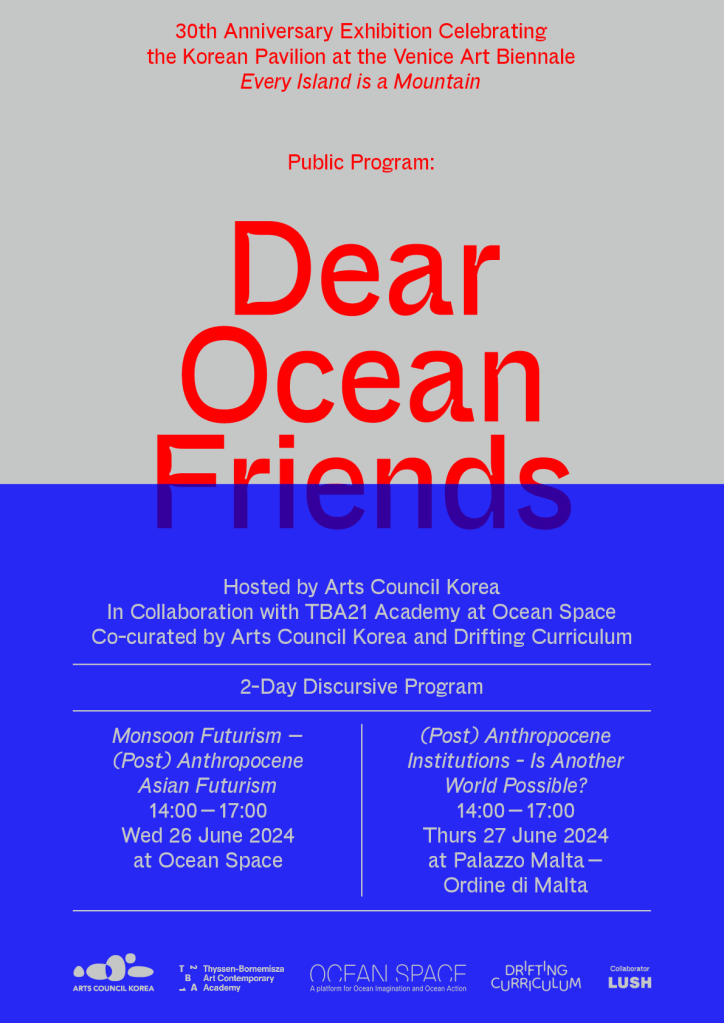
Hosted by Arts Council Korea in Collaboration with TBA21 Academy at Ocean Space
Co-curated by ARKO Art Center (Arts Council Korea) & Drifting Curriculum
 Colin Sterling